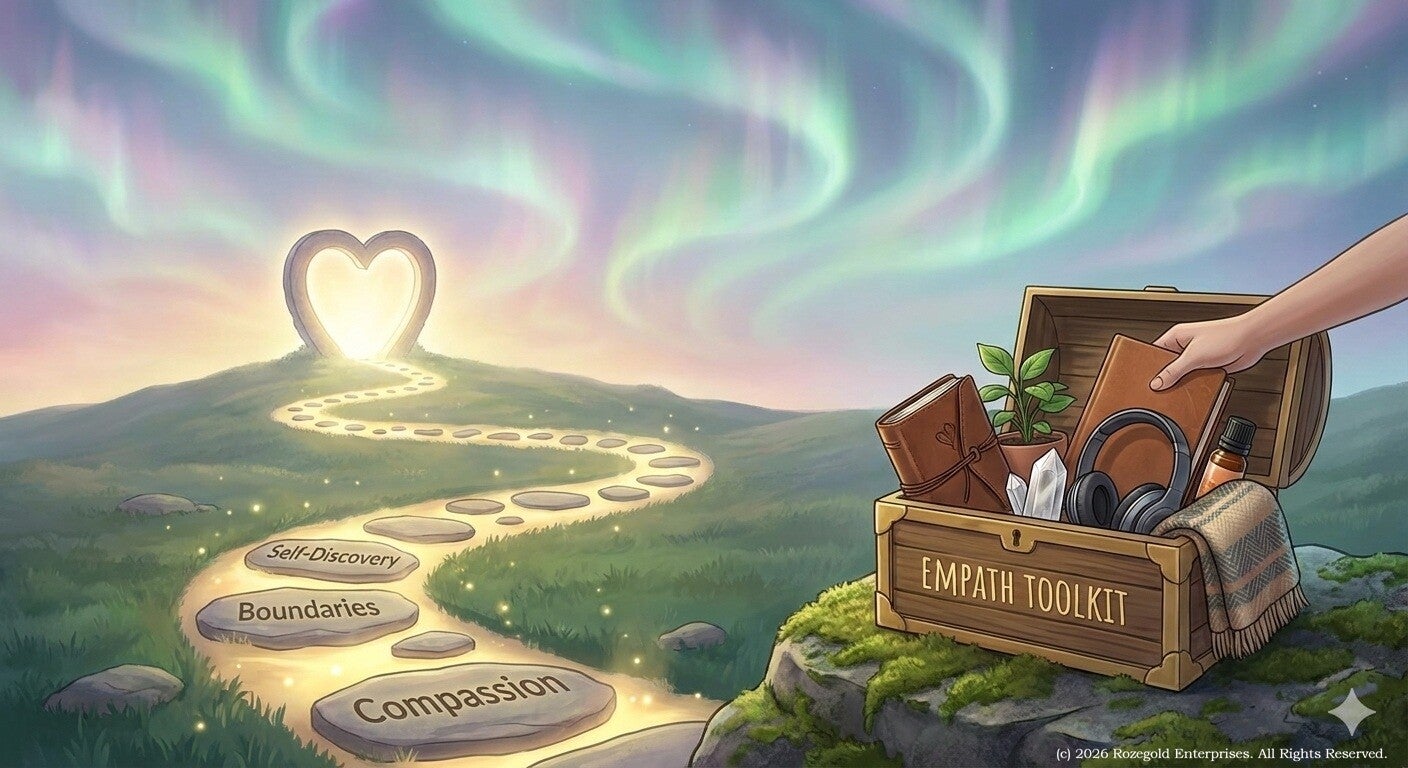
You've recognized the signs. You've acknowledged the flip side. You've named what you are: an empath. Now comes the most important question – what do you actually do with this knowledge?
Understanding that you're an empath isn't the finish line; it's the starting gate. This awareness is your invitation to step into intentional living, where your sensitivity becomes a source of strength rather than depletion. It's time to move from surviving your gift to strategically wielding it.
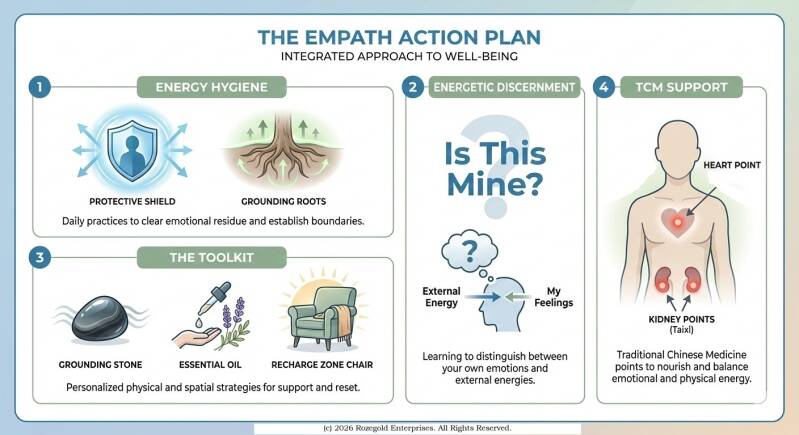
Creating Your Empath Action Plan
1. Energy Hygiene: Your Daily Non-Negotiables
Just as you wouldn't skip brushing your teeth, energy hygiene needs to become a daily practice. Think of it as clearing the emotional residue you've accumulated throughout the day.
Morning practices:
- Begin each day by setting an energetic boundary. Visualize a protective shield of light around your body – permeable enough to give love, but strong enough to deflect what isn't yours.
- Ground yourself before leaving your home. Stand barefoot for two minutes, imagining roots extending from your feet deep into the earth.
- State your intention: "I am open to compassion while remaining sovereign over my own emotional state."
Evening practices:
- Create a transition ritual when you return home. Change your clothes, wash your hands and face with intention, imagining the water washing away absorbed emotions.
- Do a body scan meditation, identifying which emotions feel foreign versus authentic to you.
- Journal three things: What emotions did I absorb today? Which were mine? What needs to be released?
2. The Art of Energetic Discernment
One of the most crucial skills for an empath is learning to distinguish between your emotions and everyone else's. This is where the real work begins.
Ask yourself regularly:
- Did this feeling start suddenly after encountering someone?
- Does this emotion have a clear source in my own life, or does it feel disconnected from my experience?
- If I physically distance myself from this person or environment, does the feeling shift?
Practice the "Is This Mine?" technique: When you notice a strong emotion arising, pause and ask three times: "Is this mine? Is this mine? Is this mine?" Notice what your body tells you. Your first instinctive answer is usually correct.
3. Building Your Empathic Toolkit
Every empath needs a personalized arsenal of techniques to navigate daily life. Here's how to build yours:
Physical Boundaries:
- Carry a grounding stone (black tourmaline, hematite, or smoky quartz) in your pocket.
- Wear specific jewelry that symbolizes your boundary – a ring you can touch when you need to "close" your energy field.
- Keep a small vial of essential oil (lavender, frankincense, or rosemary) to inhale when you need to reset.
Spatial Boundaries:
- Identify your "recharge zones" – specific places where you feel energetically restored (a corner of your home, a specific park bench, your car).
- Learn to position yourself strategically in group settings. Sitting with your back to a wall reduces the number of directions energy can come from.
- Create a sacred space in your home that is exclusively for energy clearing and emotional processing.
Relational Boundaries:
- Develop phrases that allow you to exit draining conversations: "I need to process this privately," or "I'm at capacity right now and need to step back."
- Practice the art of compassionate detachment – you can care about someone's pain without carrying it for them.
- Recognize energy vampires and limit your exposure. You are not responsible for fixing everyone.
4. Transforming Overwhelm into Wisdom
Your empathic sensitivity gives you access to information most people miss. Learn to use it strategically:
In relationships: Your ability to sense emotional undercurrents makes you exceptional at reading situations. Trust your gut when something feels "off," even if you can't articulate why. Your body knows before your mind catches up.
In your career: Channel your empathic abilities into fields where they're assets: counseling, healthcare, teaching, conflict resolution, creative arts, or healing professions. Your sensitivity isn't a liability – it's your competitive advantage.
In decision-making: Before making major decisions, check in with how each option feels in your body. Your empathic nature gives you access to intuitive wisdom that logic alone can't provide.
5. Nourishment for the Empathic Soul
Being an empath requires intentional self-nourishment, not just energy protection.
Feed your sensitivity with:
- Regular time in nature, particularly near water (oceans, rivers, lakes) which helps process and release absorbed emotions
- Creative expression that allows emotions to move through you – painting, dancing, writing, music
- Animals, who offer unconditional presence without the complexity of human emotional energy
- Silence and solitude, which aren't lonely but restorative for your overstimulated nervous system
From a Traditional Chinese Medicine perspective: Empaths often experience Kidney deficiency (exhaustion, overwhelm, depletion) and Heart/Shen disturbance (emotional turbulence, anxiety, difficulty centering).
Support your system with:
- Acupuncture points like Heart 7 (Shenmen - "Spirit Gate") to calm the mind and KI 3 (Taixi) to rebuild reserves
- Herbal formulas such as Gui Pi Tang for those who worry excessively about others, or Tian Wang Bu Xin Dan for emotional exhaustion
- Foods that nourish Kidney essence: black beans, walnuts, bone broth, seaweed, and adequate rest
6. The Empath's Greatest Power: Conscious Choice
Here's what changes everything: You are not a passive receiver of emotional energy. You have agency. You have choice.
You can choose:
- When to open your empathic channels and when to close them
- Which emotions to engage with and which to acknowledge and release
- How much emotional labor you're willing to perform in any given situation
- To honor your needs without guilt or apology
Being an empath doesn't mean you must absorb everything around you. It means you have the capacity to sense it. What you do with that information is entirely up to you.
7. Finding Your Empath Community
You are not alone, even though being an empath can feel isolating. Seek out others who understand:
- Join online communities or local meetups for highly sensitive people and empaths
- Find a therapist or coach who specializes in working with empaths
- Share your experiences with trusted friends who validate rather than dismiss your sensitivity
- Consider energy healing modalities like acupuncture, Reiki, or somatic therapy
The Invitation
So you're an empath. Now what?
Now you step into mastery. Now you stop apologizing for your sensitivity and start strategizing with it. Now you recognize that your empathic nature isn't something to fix – it's something to refine, protect, and wield with intention.
Your sensitivity is not your weakness; it's your access point to deeper wisdom, more authentic connections, and a more meaningful life. But it requires you to become the guardian of your own energy, the architect of your own boundaries, and the curator of your own emotional experience.
The world needs empaths who are empowered, not depleted. Empaths who can hold space for others without losing themselves. Empaths who know that self-care isn't selfish – it's the foundation from which all genuine service flows.
You've discovered you're an empath. Now the real journey begins: learning to thrive as one.
Your Next Steps
This week, commit to:
- Implementing one morning and one evening energy hygiene practice
- Asking "Is this mine?" at least three times when strong emotions arise
- Identifying one boundary you need to set and taking action on it
- Scheduling time in your calendar for solitude and restoration
Remember: Being an empath is not about building walls – it's about building filters. You can remain open-hearted while being energetically sovereign. You can care deeply while maintaining your center. You can be sensitive and strong.
You are an empath. And that is powerful.
About Rozegold Acupuncture
Dr. Ariela Rozegold, DACM, L.Ac., understands the unique challenges empaths face. Through acupuncture, herbal medicine, and holistic wellness strategies, she helps highly sensitive individuals strengthen their energy systems, establish healthy boundaries, and transform their sensitivity into sustainable strength.
If you're ready to move from overwhelmed to empowered, schedule a consultation to explore how Traditional Chinese Medicine can support your empathic journey.
Add comment
Comments